
Introduction
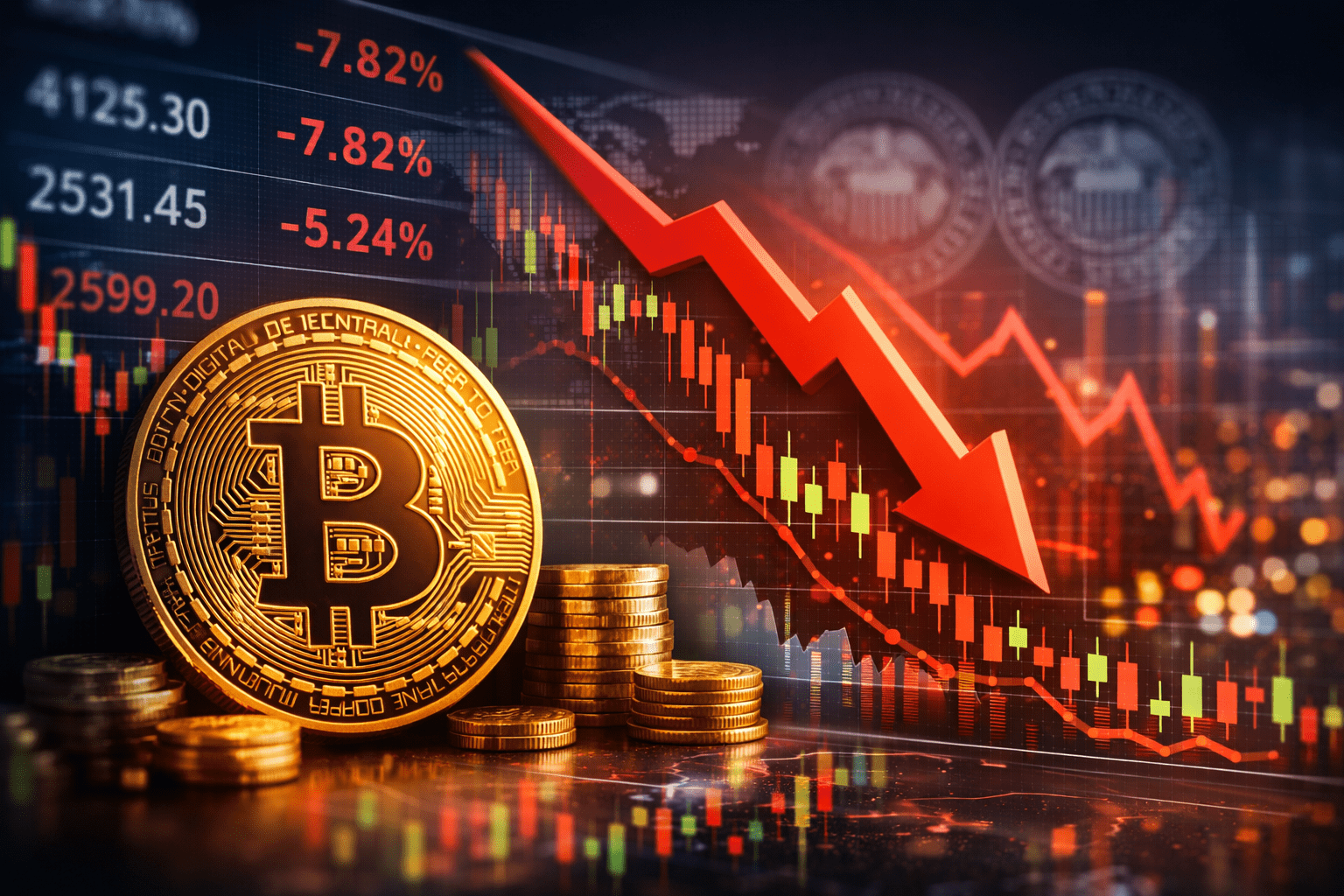
The crypto market today is facing increased volatility as Bitcoin price struggles to maintain key support levels. Investors are reacting to global economic uncertainty, tightening liquidity, and shifting institutional sentiment. As the market enters a critical phase, traders are closely watching whether Bitcoin can stabilize or if further downside is coming.
- Macro conditions and interest-rate expectations drive risk appetite.
- Spot ETF flows show whether institutional money is entering or leaving.
- Leverage amplifies moves in both directions through liquidations.
- Regulatory news can move markets sharply but often temporarily.
- Daily price checking encourages emotional decisions.
- A written plan beats reacting to any single day’s move.
In this article, we break down why Bitcoin is falling, what’s happening across the broader crypto market, and what investors should expect next.
Bitcoin Price Today: What’s Happening?
Bitcoin has moved into a short-term bearish zone after failing to hold strong resistance levels. Selling pressure has increased as traders reduce exposure to high-risk assets, leading to a ripple effect across altcoins.
Key Market Observations:
- Bitcoin struggling to regain momentum
- Increased short-term selling activity
- Lower trading volume signals market hesitation
- Altcoins following Bitcoin’s downward trend
Market sentiment remains cautious, with many traders choosing to wait for confirmation before making new entries.
Why Is the Crypto Market Falling?
Several factors are contributing to the current crypto market weakness:
1. Macroeconomic Uncertainty
Global financial markets are experiencing uncertainty due to inflation concerns, interest rate expectations, and tightening monetary conditions. Risk assets like cryptocurrencies are often the first to react.
2. Profit Booking by Investors
After strong rallies earlier, many investors are locking in profits. This creates temporary downward pressure even without negative long-term fundamentals.
3. Reduced Institutional Activity
Large investors and institutions tend to slow down during uncertain periods, reducing liquidity and increasing volatility in the market.
Altcoin Market Update
Altcoins have mirrored Bitcoin’s movement, with many popular tokens seeing short-term declines.
Current Altcoin Trends:
- High-cap altcoins showing moderate losses
- Mid-cap tokens facing sharper corrections
- Meme coins experiencing high volatility
Despite the decline, long-term development activity across blockchain ecosystems remains strong.
Is This a Buying Opportunity or a Warning?
This phase could be either a healthy correction or the start of a deeper pullback—it depends on how Bitcoin behaves near key support levels.
Bullish Scenario:
- Bitcoin holds support
- Volume increases on upward moves
- Market sentiment gradually improves
Bearish Scenario:
- Support levels break
- Panic selling increases
- Altcoins see deeper corrections
Smart investors often use such periods to accumulate gradually rather than making emotional decisions.
What Should Crypto Investors Do Now?
If you’re navigating the current crypto market, consider these strategies:
- Avoid over-leveraged trades
- Focus on strong, fundamentally sound projects
- Use dollar-cost averaging instead of lump-sum investing
- Keep an eye on market volume and trend confirmations
Risk management is more important than chasing quick profits during volatile phases.
Long-Term Outlook for Cryptocurrency
Despite short-term price fluctuations, the long-term outlook for cryptocurrency remains positive. Blockchain adoption, decentralized finance, and digital asset innovation continue to grow globally.
Market corrections are a natural part of every bull and bear cycle—and often present opportunities for disciplined investors.
The Four Forces Behind Most Price Moves
Rather than chasing individual headlines, it helps to understand the categories of pressure acting on price at any moment:
- Macro liquidity: when interest-rate expectations soften and money is cheap, risk assets including Bitcoin generally benefit. Tightening does the reverse. This is often the largest single influence.
- ETF and institutional flows: because spot ETF issuers must buy real Bitcoin to back new shares, sustained inflows create genuine buying pressure. Watching flow trends over weeks is more informative than any single day.
- Leverage and liquidations: derivatives markets amplify moves. When heavily leveraged positions get force-closed, prices can cascade far beyond what the original news justified.
- Regulation and policy: announcements shift sentiment quickly, though initial reactions frequently overshoot and partially reverse.
Why Volatility Is Structural, Not a Malfunction
Newcomers often treat volatility as evidence something is broken. It isn’t — it’s a structural feature of an asset that trades globally, 24 hours a day, with no circuit breakers, a relatively small market capitalisation compared to traditional assets, and heavy use of leverage.
Traditional markets close overnight and pause during extreme moves. Crypto never does, so pressure that would build up quietly elsewhere expresses itself immediately in price. Understanding this reframes volatility from alarming to expected, which makes it far easier to hold a position through it. Our guide to market cycles covers how these swings pattern over longer periods.
How to Follow Prices Without Being Ruled by Them
- Zoom out. A move that looks catastrophic on a one-hour chart often vanishes on a weekly view. Our chart reading guide explains timeframe discipline.
- Check sentiment, not just price. The Fear & Greed index on our live prices page adds useful context to a number.
- Decide rules in advance so a red day triggers your plan, not your panic.
- Use a systematic approach like dollar-cost averaging, which makes daily prices largely irrelevant.
- Remember the tax angle: in India, selling into volatility triggers a taxable transfer at 30% plus TDS, as our tax guide explains.
Answers to Common Questions
Why did Bitcoin move without any news?
Large moves frequently originate from market structure rather than news — a cluster of leveraged liquidations, a large holder rebalancing, or thin weekend liquidity can all move price with no headline attached.
Should I buy the dip?
If it’s part of a planned accumulation strategy, dips are simply cheaper entries. If it’s an impulsive reaction to a falling price, it’s speculation dressed up as strategy. The distinction is whether you decided beforehand.
How much volatility is normal?
Historically, Bitcoin has experienced drawdowns exceeding 50% multiple times, even within broader uptrends. Position sizes should assume this can happen again.
Where People Go Wrong Watching Prices
The most damaging habit isn’t picking the wrong asset — it’s checking prices constantly. Frequent monitoring converts normal volatility into a stream of emotional prompts to act, and acting on emotion is what separates most losing investors from patient ones. Ironically, the people who check least often tend to hold longest and fare better. Price awareness is useful; price obsession is expensive.
The Bottom Line
The crypto market today is experiencing temporary pressure, driven by macroeconomic factors and investor caution. While Bitcoin’s short-term movement remains uncertain, long-term fundamentals continue to support the growth of the digital asset ecosystem.
Stay informed, stay patient, and always invest responsibly.