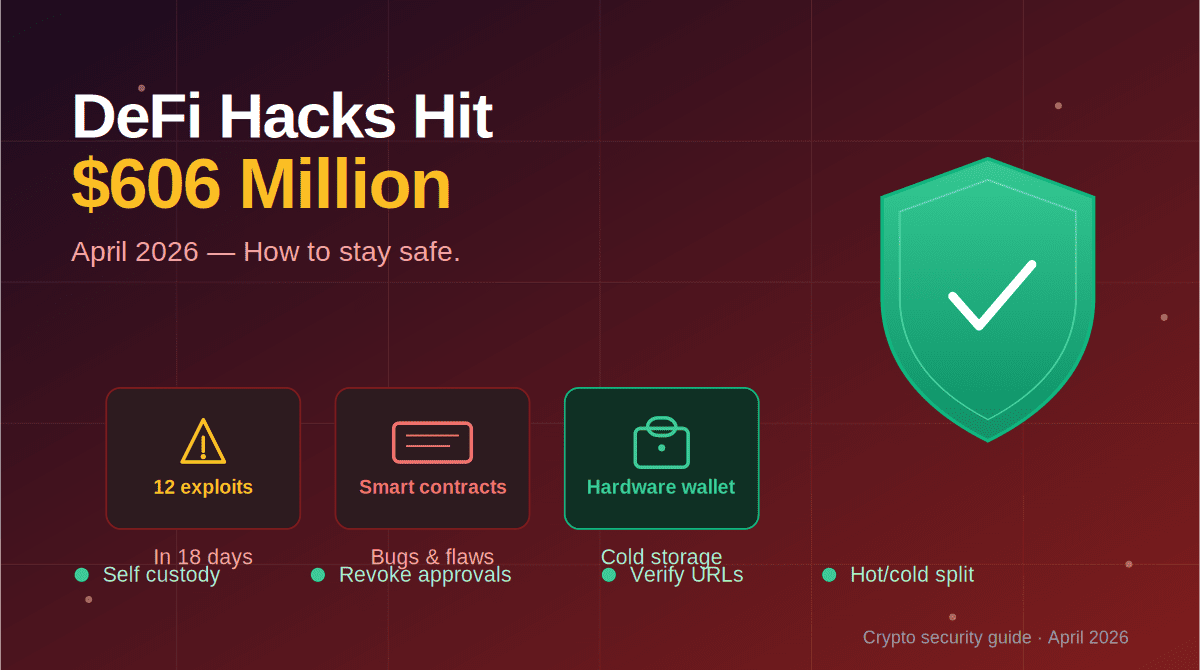
April 2026 will be remembered as one of the most painful months on record for decentralized finance. In just eighteen days, attackers drained more than 606 million dollars from DeFi protocols across twelve separate exploits. Two of those attacks — on liquid staking platform KelpDAO and decentralized exchange Drift — accounted for roughly 577 million dollars on their own.
The market itself has been moving in the opposite direction. Bitcoin has been trading near multi-month highs around 77,000 dollars, ETF inflows have surged, and the total crypto market capitalization has climbed back above three trillion dollars. So the headlines tell a split story: capital is rushing into crypto while, at the same time, hundreds of millions are flowing out of vulnerable smart contracts.
If you hold any crypto, this matters. Whether you use a major centralized exchange or a self-custody wallet, the same lessons from this month apply to you. This guide walks through what actually happened, why DeFi keeps getting hit, and the practical steps any user can take today to lower the chance of being the next victim.
What Exactly Is a DeFi Hack?
The phrase “crypto hack” gets used loosely in the news, so it helps to be specific. A DeFi hack is an attack against a decentralized application — usually a lending platform, exchange, or yield protocol — where attackers exploit a flaw in the protocol’s smart contract code or its supporting infrastructure to drain funds.
This is different from someone phishing your seed phrase or stealing your laptop. In a DeFi hack, the protocol itself is the victim, and every user with funds locked in that protocol can be affected at once. Even if you did everything right on your end, your money can be at risk because the contract holding it had a flaw.
Common categories of DeFi attacks include:
- Smart contract exploits — bugs in the code that let an attacker withdraw more than they deposited, mint tokens out of thin air, or bypass access controls.
- Oracle manipulation — tricking a protocol’s price feed so it values an asset incorrectly during a trade or liquidation.
- Flash loan attacks — borrowing huge sums of crypto for the duration of a single transaction and using that capital to manipulate markets or drain pools.
- Bridge exploits — attacks on the contracts that move tokens between different blockchains, which often hold large pools of locked assets.
- Access control failures — admin keys being stolen, or privileged functions being left open to anyone.
- Governance attacks — buying enough governance tokens to push through a malicious proposal that drains a treasury.
April’s losses came from a mix of these categories.
Why April 2026 Was So Bad
Three things came together to make this month particularly damaging.
The market is hot again. When prices rally, more capital flows into DeFi protocols looking for yield. Bigger pools of locked value mean bigger targets. Attackers know this and time their work accordingly.
Newer protocols launched without enough audits. Liquid staking, restaking, and points programs have all attracted billions in deposits over the past year. Some of these systems are genuinely innovative, but innovation moves faster than security review. Code that has not been battle-tested through long live use is more likely to have a sleeping bug.
Composability cuts both ways. One of DeFi’s strengths is that protocols stack on top of each other — a token deposited in one protocol can be used as collateral in another, then automatically rebalanced by a third. When one of those layers fails, the damage cascades through every protocol connected to it.
The KelpDAO and Drift attacks, which made up the bulk of the month’s losses, hit two protocols that millions of dollars in user funds had been routed through. Even users who never directly visited those sites were affected because the assets they held depended on those underlying systems working correctly.
The Hard Truth: Audits Are Not a Guarantee
When you read about a DeFi protocol, you will often see logos from auditing firms displayed prominently. An audit is genuinely valuable — a good audit catches many of the issues that would otherwise become catastrophic. But an audit is a snapshot, not a shield.
Here is what an audit actually means:
- A team of security engineers reviewed the code at a specific point in time.
- They tested for known vulnerability patterns and tried to break the system within their time budget.
- They produced a report listing issues they found and the team’s response to each.
Here is what an audit does not mean:
- That the code is now safe forever.
- That every code change made after the audit is also safe.
- That economic attacks involving multiple protocols interacting were considered.
- That the underlying assumptions about oracles, governance, or admin keys are correct.
Several of April’s exploited protocols had been audited. Some had been audited multiple times. The lesson is not that audits are pointless — it is that audits are one layer of defense and should never be your only one.
Where Your Risk Actually Lives
Your overall safety in crypto depends on the weakest link in a chain that runs from your hardware all the way to the smart contract holding your funds. Most users focus on the wrong link.
The chain looks roughly like this:
- Your device — the laptop or phone you use.
- Your browser and extensions — wallets like MetaMask, the websites you connect to, the browser extensions installed alongside.
- Your seed phrase — the twelve or twenty-four words that recover your wallet.
- The wallet software — the code that signs transactions on your behalf.
- The smart contract you interact with — the protocol where your assets ultimately sit.
- The supporting infrastructure — bridges, oracles, governance, and admin keys.
A stolen seed phrase wipes you out instantly. A malicious browser extension can sit silently for months and then drain you the moment you connect to a high-value protocol. A buggy contract takes you down with everyone else using it. Each layer needs its own attention.
Practical Steps to Lower Your Risk Today
You will never reduce DeFi risk to zero while still using DeFi. You can, however, dramatically lower the chance of losing everything in a single bad day. Here are the practices that have the highest effect for the lowest effort.
Use a hardware wallet for any meaningful balance. A hardware wallet keeps your private keys on a separate device that signs transactions offline. Even if your computer is fully compromised, an attacker still cannot move funds without physical access to the device and its PIN. For balances above what you would carry in cash, this is the single most important upgrade you can make.
Split funds between hot and cold wallets. Treat your hot wallet like a checking account — small balances for daily activity. Treat your hardware wallet like a savings account — long-term holdings that rarely move. When something goes wrong with a protocol you used, the damage is capped at the hot wallet balance.
Never type your seed phrase into anything. Not a website, not a “wallet recovery” support form, not a browser-based password manager, not a screenshot, not an email draft. Real wallets and real exchanges will never ask you to enter your seed phrase into their interface. Anyone who does is trying to steal from you.
Use a separate browser profile or device for crypto. A clean browser profile with only your wallet extension installed, used only for crypto sites, removes a huge category of risk. Random extensions you installed last year can read everything on every page you visit, including your wallet activity.
Bookmark the real URLs of the protocols you use. Phishing sites that copy the look of popular DeFi platforms are everywhere. They reach you through search ads, fake support accounts, and lookalike domains. Always reach a protocol through a bookmark you saved when you knew the URL was correct.
Read what you are signing. Wallet pop-ups now show you the function being called and the assets at risk. Take five extra seconds. If you are signing an unlimited token approval to a contract you have never used before, ask yourself whether that level of permission is actually needed.
Revoke old token approvals regularly. When you give a DeFi protocol permission to spend your tokens, that permission often stays active forever unless you remove it. If that protocol is later exploited, the attacker can use your old approval to drain your wallet. Use a revocation tool every few months to clean up permissions you no longer need.
Be skeptical of new and high-yield protocols. A 2 percent yield on a battle-tested protocol that has held billions for years is much safer than a 200 percent yield on a protocol launched last week. The high yield is the marketing department telling you the risk is high.
Keep the rest of your security tight. Two-factor authentication on every exchange and email account, using an authenticator app rather than SMS where possible. Strong unique passwords for each service. Software kept up to date. None of this is glamorous, and all of it matters.
Should You Even Use DeFi?
After reading the list of risks, this is a fair question. The answer depends on what you are trying to do.
If you want long-term exposure to crypto and have no interest in yield strategies, a regulated exchange or a spot ETF is a much simpler path. You give up the on-chain features, but you also give up most of the smart contract risk.
If you want to use specific DeFi features — non-custodial trading, on-chain lending, yield strategies, stablecoin payments — then DeFi is the only place those features exist. The right approach is to engage with full awareness of the risks, size your positions accordingly, and follow the security practices above.
There is no shame in choosing a smaller, simpler exposure. Every cycle, the people who survive long enough to see the next one are usually the ones who never put themselves in a position where a single bad week could end everything.
What to Do If You Get Hit
If you suspect your wallet has been compromised, act fast and act calmly.
- Move any remaining funds to a brand-new wallet generated on a clean device. Do not “fix” the old wallet.
- Revoke all token approvals from the compromised wallet.
- Change passwords on related email accounts and exchanges.
- Document the transactions involved. Block explorers preserve everything publicly, but having your own record helps for tax reporting and for any law enforcement reports.
- Be extremely wary of “recovery services” that contact you afterwards. Almost all of them are secondary scams. Real recovery in crypto is rare and almost never starts with a stranger sliding into your direct messages.
If you held funds in a protocol that was exploited, watch the project’s official channels for any compensation announcement. Some protocols use insurance funds or treasury reserves to make users whole, partially or fully. Others do not. The recovery rate varies enormously by project.
The Bigger Picture
The amount of money lost to DeFi hacks each year tells a story about a financial system being built in public. Every exploit is, in a real sense, a stress test that the traditional financial system was spared from because its software is hidden behind firewalls and lawyers. The crypto industry takes those hits in the open.
That openness has a long-term advantage. Each major attack drives audits, formal verification, and security research forward. Bug bounty programs now pay out millions for a single critical finding. Insurance products for smart contract risk have grown into a real market. None of this existed five years ago.
For users, though, the takeaway is more immediate. April 2026 is not an unusual month — it is a louder version of the regular pattern. Build the habits now, before the next bad month, so that when it arrives you read the headline as news rather than as a personal disaster.
Frequently Asked Questions
Is my crypto safe on a centralized exchange? A regulated centralized exchange protects you from smart contract risk but introduces a different risk: the exchange itself. Major exchanges have been hacked, gone bankrupt, or frozen withdrawals in the past. The phrase “not your keys, not your coins” exists for a reason. For long-term holdings, self-custody on a hardware wallet is generally considered safer.
How do I know if a DeFi protocol is safe to use? You can never be certain. Look at how long it has been live, the size of its audits and bug bounty, the experience of the team, whether it has survived previous market stress, and how transparent the developers are. None of these are guarantees, but together they give you a meaningful picture.
What is the safest type of crypto wallet? A hardware wallet from a reputable manufacturer, with the seed phrase stored offline (ideally on metal, in two separate physical locations), used only for high-value holdings. For daily activity, a software wallet on a clean device is acceptable as long as the balance stays small.
Can I get my money back if a protocol is hacked? Sometimes. It depends entirely on the project. Some have insurance funds, some negotiate with the attacker, some absorb the loss into the treasury, and some do nothing. Assume any money you put into DeFi could be lost, and only deposit what you can afford to lose.
Are stablecoins safer than other crypto? Stablecoins reduce price volatility but do not reduce smart contract risk. A stablecoin sitting in a hacked DeFi protocol is just as gone as any other token sitting in that protocol. Holding stablecoins on a hardware wallet, however, is generally lower risk than holding volatile tokens.
Final Thoughts
The 606 million dollars stolen from DeFi protocols in the first eighteen days of April 2026 is a reminder that decentralization is not the same as safety. Every layer of the stack between you and your money — your device, your wallet, your approvals, the contract, the bridge, the oracle — is something an attacker can probe.
The good news is that most users get hit not because of some exotic exploit but because of the basics: reused passwords, seed phrases stored badly, unlimited token approvals left open, and trust given to interfaces that did not deserve it. Fixing those things does not require deep technical knowledge. It requires an afternoon of attention and the discipline to repeat the habits going forward.
If this article saves even one reader from a bad week, it has earned its place on the internet.
Disclaimer: This article is for educational and informational purposes only and is not financial, legal, or security advice. Cryptocurrency and DeFi participation carry substantial risk, including the total loss of funds. Always do your own research, use reputable services, and consult qualified professionals when needed. Mention of any protocol, attack, or platform is for context and is not an endorsement.
Found this useful? Share it with anyone who holds crypto, and bookmark this site for more original explainers on blockchain, DeFi, and digital asset safety.