
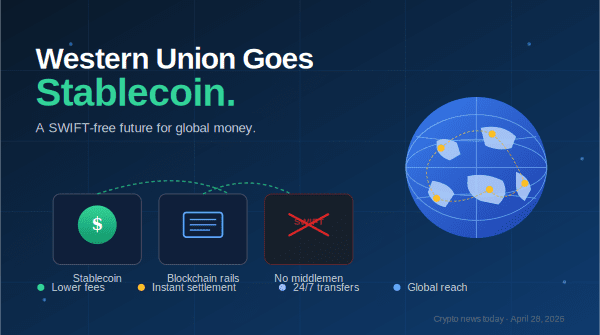
For the better part of two centuries, Western Union has been a synonym for moving money across borders. The company that started life sending telegraph messages in 1851 became the default option for cash remittances in dozens of countries, with storefronts in places where banks barely reach. This week, that 175-year-old institution made an announcement that would have sounded like science fiction even five years ago: it is preparing to launch its own stablecoin and use blockchain rails to settle global transactions, bypassing the traditional SWIFT messaging network.
If you have ever sent money to family abroad, paid a freelancer in another country, or watched a foreign exchange fee eat into your transfer, this matters to you. The plan is not just a press release — it is a signal that the rails the world has used to move money for half a century are starting to be rebuilt in public.
This guide walks through what Western Union actually announced, why a stablecoin makes sense for a remittance giant, how it would compare to existing crypto and traditional options, and what could go right and wrong from here.
What Western Union Actually Said
The company’s chief executive confirmed publicly that Western Union is exploring a stablecoin launch, with the goal of settling cross-border transactions without relying on the SWIFT network. Two pieces stood out from the announcement.
The first is the stablecoin itself — a digital token pegged to a stable value, almost certainly the U.S. dollar, that would move between the company’s accounts and partners on a blockchain. The second is a stablecoin-linked card, designed to let users move between crypto and local currency at the point of payment or cash-out.
This is not Western Union dabbling at the edges. The company is one of the largest remittance operators in the world, processing tens of billions of dollars in transfers every year through a network of physical agents and digital channels. Putting that volume on blockchain rails would be one of the largest real-world deployments of stablecoins to date.
Why SWIFT Has Been the Bottleneck for So Long
To understand why this announcement matters, it helps to understand what SWIFT actually is — and what it is not.
SWIFT is not a money-moving network. It is a messaging network. When you send a wire transfer from one country to another, SWIFT carries the instructions between the banks involved. The actual money moves through a chain of correspondent banks, each holding accounts on behalf of the others, settling balances among themselves over hours or days.
This system has worked for decades, but it carries baked-in friction:
- It is slow. International wires often take one to three business days to settle, sometimes longer if a bank in the chain flags a transaction for review.
- It is expensive. Each intermediary takes a cut. Foreign exchange spreads add another layer. End users frequently lose 3 to 7 percent of the value of their transfer in combined fees.
- It is opaque. Once a wire leaves your bank, you typically cannot see where it is in the chain until it lands.
- It is dependent on relationships. Smaller banks in emerging markets often cannot move dollars at all without going through a larger correspondent bank that may or may not be willing to serve them.
For a remittance company, every one of those frictions is a cost — either paid by the customer, the company, or both. Stablecoins offer a way to skip nearly all of them.
How a Stablecoin Settlement Layer Would Actually Work
The mechanics are simpler than they sound.
When you send money internationally today, your dollars effectively get parked in your bank, instructions get sent to a partner bank in the destination country, and the recipient is paid out of that partner bank’s pool of dollars. The two banks then settle their balance through correspondents over time.
In a stablecoin world, your dollars get converted into a token that represents a dollar one-for-one. That token moves on a blockchain, often in seconds, to the destination side. The recipient’s local partner converts the token back into local currency and pays out the cash. Settlement is essentially instant. There is no chain of correspondent banks, no SWIFT message, no waiting room.
For Western Union specifically, this could play out in several ways:
- Internal settlement. The company can use stablecoins to move value between its own offices and partners around the world without needing to pre-fund correspondent accounts in every currency.
- Customer-facing. Customers could send and receive stablecoins directly, especially in markets where mobile wallets are already common.
- Hybrid. Most realistically in the near term, the company keeps its familiar storefront experience for users while quietly running stablecoins on the back end. Senders pay in cash, recipients get cash, and the value moves between them through a token in the middle. The user never has to know what a blockchain is.
What This Means for Everyday Senders
If you send money to family in another country, or receive money from family abroad, several things could change over the next few years.
Lower fees. When the underlying settlement is faster and cheaper, there is room for transfer prices to come down. Whether that saving reaches the customer depends on competition. Companies that adopt stablecoin rails will be able to undercut those that do not.
Faster transfers. A stablecoin transfer can settle in seconds. Even if the cash-out side at the destination still takes hours during the receiving agent’s business hours, the value at least lives in a settled state instead of in transit.
24/7 movement. Traditional bank rails close on weekends and holidays. A stablecoin network does not. Money sent on a Saturday no longer has to wait until Monday for the underlying settlement to begin.
More transparency. Public blockchains let you verify that funds have moved, even if you do not understand the underlying technology. Wallet apps can show transfers in real time.
Easier cross-currency. With a dollar-pegged stablecoin in the middle, transfers between two non-dollar currencies no longer have to detour through the U.S. banking system every time.
There are also things that probably will not change immediately. Regulations require companies to verify identities, screen for sanctions, and report suspicious activity. Those processes still need to run, and they take time. Stablecoins make the settlement faster but do not remove the compliance steps around it.
Why Stablecoins Are Suddenly Everywhere
Western Union’s plan is not happening in a vacuum. Over the past year, a quiet wave of major institutions has signed on to stablecoin strategies:
- Major U.S. banks have launched dollar-token products for institutional clients.
- Comprehensive stablecoin legislation has passed in the United States, giving issuers a clear federal framework.
- The European MiCA framework is fully operational.
- Cross-border business-to-business payments using stablecoins are projected by industry research to reach trillions of dollars annually within a decade.
In other words, the rails Western Union is preparing to use are no longer experimental. They are being built and lit up by some of the largest financial institutions in the world. A remittance giant joining that movement is significant, but it is not surprising.
How This Compares to Existing Crypto Remittance Options
People have been sending crypto across borders for years. Workers send Bitcoin or stablecoins home, freelancers invoice in USDT, and dollar-pegged tokens already account for a meaningful share of international transfers in some emerging markets.
What Western Union brings is different in three ways.
Scale and reach. The company has hundreds of thousands of physical locations and licenses to operate in nearly every country. Crypto-native services often stop at the wallet — turning a token into local cash still requires a partner. Western Union already has that partner network.
Trust signals for older users. A person sending money to a parent in another country may not be ready to walk them through downloading a wallet app, securing a seed phrase, and verifying a receiving address. They will, however, walk into a Western Union counter. Wrapping stablecoin rails inside a familiar brand removes a huge psychological barrier.
Regulatory infrastructure. Compliance, anti-money-laundering, and sanctions screening already exist at the company. Crypto-native services have spent the last few years catching up. Western Union starts with all of that already in place.
The trade-off is that a Western Union stablecoin will almost certainly carry fees and limits that pure crypto rails do not. The convenience of a cash-out window comes with a price.
The Risks and Open Questions
This is not a story without complications.
Regulatory approval. A stablecoin from a major regulated money transmitter has to satisfy banking, securities, and money-services regulators in many jurisdictions. The process is unlikely to be quick.
Choice of blockchain. Western Union has not publicly committed to a specific network. The choice will affect cost, speed, and which other parts of the ecosystem the token can plug into. A public chain offers reach. A private or permissioned chain offers control. Most likely, the answer ends up being a mix.
Reserves and audits. A stablecoin is only as trustworthy as the assets backing it and the transparency of the audits. Trust will depend on whether the company adopts the strict reserve and disclosure standards that the strongest stablecoins have set as the bar.
Existing partner relationships. Banks and remittance partners that currently earn fees on Western Union flows may not love being routed around. Some of those relationships will need to be renegotiated rather than replaced.
User education. Stablecoins behave differently from cash. They live on chains, can be sent to wrong addresses irreversibly, and may have tax implications. Even with a smooth user interface, the underlying complexity does not disappear.
Geopolitics. SWIFT is not just a payment network. It is also a tool of foreign policy, used to enforce sanctions. Any system that bypasses it will be watched closely by regulators and policymakers, and the rules around stablecoin issuers blocking specific addresses are still evolving.
What to Watch Over the Next Year
A few signals will tell you whether the Western Union plan is on track or losing momentum.
- The launch corridor. Most large stablecoin deployments start in a single corridor — say, U.S. to Mexico, or U.S. to the Philippines — before expanding. Watch where the company runs its first pilots.
- Reserve disclosures. A monthly attestation from a major audit firm is the gold standard. Anything less should be a yellow flag.
- Fees on the new product. If the rollout brings real fee reductions for end users, that is the strongest evidence that stablecoin rails are doing what supporters claim.
- Competitor responses. Watch what other major remittance companies and money-transfer fintechs do. If they roll out their own stablecoin partnerships, expect the whole industry to move quickly.
- Regulatory tone. Public statements from U.S. and European regulators will shape how aggressively the product can launch and where.
The Bigger Story
For most of the past decade, the headline narrative around crypto has been speculation. Tokens going up. Tokens going down. Memecoins, NFT cycles, lawsuits, and bankruptcies. The deeper, slower story has been the gradual rebuilding of the financial system on shared infrastructure.
A 175-year-old remittance company announcing a stablecoin is part of that quieter story. So is a major U.S. bank issuing a deposit token. So is comprehensive stablecoin legislation passing. So is a real estate fund tokenizing units on a public ledger. None of these moves is a dramatic crash or a vertical rally. They are the slow accumulation of changes that, taken together, mean the system that handles your salary, your savings, and your transfers will look different in five years than it does today.
For users, the practical takeaway is simple. The cost of moving money internationally is going to come down. The speed is going to come up. And the brands you already know are increasingly going to be the ones running it on crypto rails — even if they never make you think about crypto at all.
Frequently Asked Questions
Is Western Union launching its own cryptocurrency? Not exactly. A stablecoin is a token designed to hold a steady value, usually pegged one-to-one with a national currency like the U.S. dollar. It is not the same as a volatile cryptocurrency like Bitcoin. The company’s plan is to use a stablecoin as a settlement tool, not as an investment product.
Will I need a crypto wallet to use it? Most likely no, at least for the standard sender and receiver experience. The company can run stablecoins on the back end while keeping the cash-in and cash-out experience the same as today. A separate wallet-based product may exist for users who want it.
How does this compare to sending USDT or USDC directly? A direct stablecoin transfer through a crypto exchange or wallet can be faster and cheaper, but it requires both sides to be set up for crypto. The Western Union approach trades some of that speed for vastly broader reach and a familiar interface.
Could this replace SWIFT entirely? Not on its own, and not soon. SWIFT carries an enormous volume of bank-to-bank messages tied to many products, not just remittances. A stablecoin layer is more likely to take share in specific corridors and use cases over years, not flip the whole system overnight.
Is my money safe in a stablecoin? That depends on the issuer’s reserves, the regulatory regime, and the specific product structure. A well-regulated, fully-reserved, regularly-audited stablecoin from a licensed issuer is significantly safer than an unregulated token from an unknown team. Always check what backs the token and who is overseeing it.
Will fees actually come down for end users? That is the test. The technology allows for lower fees. Whether competition forces companies to pass those savings through to customers will depend on market dynamics over the next few years.
Final Thoughts
When a 175-year-old company that helped invent global money transfer announces it is moving onto blockchain rails, the conversation about whether crypto is real or relevant is essentially over. The interesting questions now are about execution: which corridors first, what the user experience looks like, how regulators respond, and how quickly fees actually drop for the people who depend on remittances every month.
The next time you send money across a border, the rails underneath your transaction may already have been quietly upgraded. You will not see them. You will just notice that the money got there faster and cost a little less. That is what real adoption looks like — not a flashy headline, but a familiar service that simply works better than it did before.
Disclaimer: This article is for educational and informational purposes only. It is not financial, legal, or investment advice. Cryptocurrencies, stablecoins, and crypto-related products carry risk, including the loss of funds. Regulatory frameworks vary by country and continue to evolve. Always do your own research and consult a qualified professional before making financial decisions.
Found this useful? Share it with anyone who sends or receives money across borders, and bookmark this site for more original explainers on crypto, blockchain, and the future of finance.