
Introduction
Privacy has become one of the biggest concerns in the cryptocurrency world. While blockchain technology offers transparency, every transaction can often be traced through public explorers. This creates challenges for investors, traders, freelancers, and businesses that value financial privacy.
- Public blockchains expose your full balance and history by default.
- Address reuse is the biggest self-inflicted privacy leak.
- Wallets can leak your IP to servers even without KYC.
- Coin control and fresh addresses meaningfully improve privacy.
- Privacy tools must be used within your local laws.
- Privacy protects against profiling and targeting, not just surveillance.
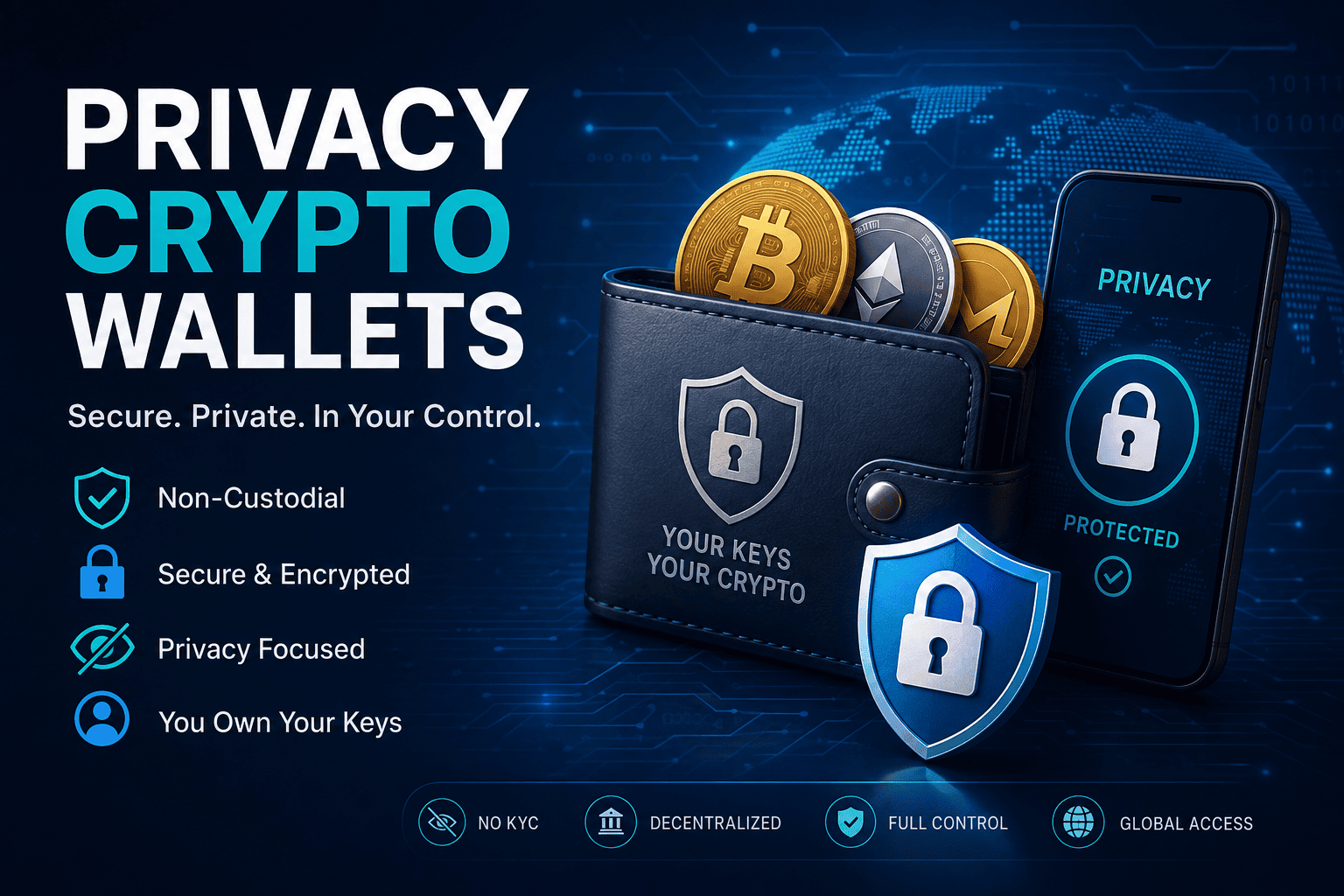
A privacy-focused cryptocurrency wallet helps users maintain control over their assets while reducing unnecessary exposure of personal information. Unlike centralized exchanges that require identity verification and store customer data, many modern wallets allow users to hold their own private keys without sharing sensitive information.
In this guide, we’ll explore what privacy crypto wallets are, why they matter, their key features, and how to choose the best wallet for your needs in 2026.
Why Privacy Matters in Cryptocurrency
Many people believe cryptocurrency transactions are completely anonymous. In reality, most public blockchains are transparent. Anyone can view wallet balances and transaction histories if they know a wallet address.
Privacy is important because it helps:
- Protect financial information
- Prevent targeted scams
- Reduce phishing attacks
- Improve personal security
- Keep investment strategies private
- Maintain financial freedom
Good privacy practices don’t mean hiding illegal activities. Instead, they help users protect their personal financial information from unnecessary exposure.
What is a Privacy-Focused Wallet?
A privacy-focused wallet is a cryptocurrency wallet designed to minimize personal data collection while giving users full control over their private keys.
Most privacy wallets include features like:
- Non-custodial storage
- Local key generation
- No mandatory KYC
- Open-source software
- Transaction privacy tools
- Multiple blockchain support
These wallets allow users to control their cryptocurrency instead of relying on centralized services.
Features to Look for
Non-Custodial Design
The wallet should give you complete ownership of your private keys.
Remember:
Not your keys, not your coins.
Open Source
Open-source wallets allow security researchers to inspect the code, making them more trustworthy than closed-source alternatives.
Backup Recovery Phrase
Always choose wallets that provide a secure recovery phrase.
This allows recovery if your phone or computer is lost.
Strong Encryption
Modern wallets encrypt private keys locally before storing them.
This provides an additional security layer.
Multi-Chain Support
Instead of using different wallets for different coins, many wallets support:
- Bitcoin
- Ethereum
- Solana
- BNB Chain
- Polygon
- Avalanche
- Base
- Arbitrum
Managing everything in one place improves convenience.
Best Types of Privacy Wallets
Hardware Wallets
Hardware wallets store keys offline.
Advantages:
- Highest security
- Immune to most malware
- Best for long-term investors
Mobile Wallets
Mobile wallets are convenient for daily transactions.
Advantages:
- Easy access
- QR payments
- Fast transfers
- DeFi support
Desktop Wallets
Desktop wallets are ideal for users managing larger portfolios from a personal computer.
Benefits include:
- Better portfolio management
- Advanced security
- Larger screen
- Better integration with crypto tools
Browser Extension Wallets
Popular among Web3 users.
Useful for:
- NFT trading
- DeFi
- DAO voting
- DApps
Privacy Tips Every Crypto User Should Follow
Never Reuse Wallet Addresses
Generating a new receiving address improves privacy.
Use Strong Passwords
Create long and unique passwords for every wallet.
Password managers can help.
Enable Two-Factor Authentication
Whenever possible, enable 2FA on services connected to cryptocurrency.
Keep Recovery Phrase Offline
Never:
- Save it in email
- Upload to cloud storage
- Share with anyone
Write it on paper or store it securely offline.
What Actually Leaks When You Use a Wallet
Most people assume a non-custodial wallet is private because it required no ID. Several leaks happen regardless:
- Address reuse: receiving multiple payments to one address lets anyone group them and observe your entire balance and history.
- IP exposure: most wallets query a server to fetch balances, revealing your IP alongside your addresses.
- Change linkage: transaction change outputs can connect addresses you believed were separate.
- Exchange linkage: once you withdraw from a KYC exchange, that address is tied to your verified identity permanently.
As our wallet address guide explains, blockchains are pseudonymous — and pseudonymity collapses the moment one address links to a name.
Features That Genuinely Improve Privacy
- Automatic fresh addresses for every incoming payment, so payments can’t be trivially grouped.
- Your own node or trusted server connection, which stops a third party from seeing which addresses you query.
- Tor or proxy support to avoid exposing your IP.
- Coin control, letting you choose which funds to spend so unrelated coins aren’t merged into one transaction.
- Open-source code that independent researchers can audit.
Sensible Habits That Cost Nothing
- Never reuse a receiving address across different senders.
- Keep exchange-withdrawn funds separate from funds you want unlinked.
- Avoid publishing an address publicly and then using it for everything.
- Use a separate wallet for DeFi experiments and NFT mints.
- Remember privacy tools don’t change tax obligations — Indian VDA rules apply regardless, as our tax guide covers.
Quick Questions Answered
Does a hardware wallet make me private?
No. Hardware wallets protect your keys from theft; they don’t hide your on-chain activity. Security and privacy are separate problems requiring separate tools.
Is using privacy features legal?
Privacy practices like fresh addresses are simply good hygiene and unremarkable. Specific tools face varying regulatory treatment by jurisdiction, so verify local rules and always meet reporting obligations.
Can I be private after using a KYC exchange?
Partially at best. Funds withdrawn from a verified account start with a known link, and that connection persists on-chain permanently.
The Framing Worth Rejecting
Privacy discussions in crypto often get shut down with “only criminals need privacy.” Applied consistently, that logic would mean nobody should have curtains, sealed envelopes or a private bank balance. On a public ledger, the practical risks of full transparency are mundane rather than sinister: a counterparty seeing your entire net worth before negotiating, a competitor mapping your business payments, or someone identifying you as worth robbing. Wanting the financial privacy that traditional banking provides by default is an ordinary expectation, not a confession.
Update Wallet Software
Developers regularly fix security vulnerabilities.
Keeping software updated reduces risk.
Common Mistakes
Many users unknowingly reduce their privacy.
Avoid these mistakes:
- Sharing wallet screenshots
- Posting wallet addresses publicly
- Storing recovery phrases digitally
- Downloading fake wallets
- Ignoring software updates
- Clicking unknown wallet links
How Privacy Wallets Improve Security
Privacy wallets reduce the amount of personal information connected to your digital assets.
Benefits include:
- Better identity protection
- Reduced scam exposure
- Improved transaction confidentiality
- Safer long-term investing
- Greater financial independence
Are Privacy Wallets Legal?
Yes.
Privacy wallets are legal in most countries because they simply allow users to manage their own cryptocurrency securely.
However, users should always follow the laws and regulations applicable in their country regarding cryptocurrency ownership and taxation.
Future of Privacy in Crypto
Privacy technology continues to evolve.
Emerging innovations include:
- Zero-Knowledge Proofs (ZK)
- Decentralized Identity
- Confidential Transactions
- Layer-2 Privacy Solutions
- AI-powered Fraud Detection
- Cross-chain Security
As blockchain adoption increases, protecting personal financial information will become even more important.
Frequently Asked Questions
Are privacy wallets anonymous?
No wallet provides complete anonymity. However, privacy-focused wallets significantly reduce unnecessary exposure of your financial information.
Are non-custodial wallets safer?
They provide greater control because only you hold the private keys. However, you are also responsible for securely storing your recovery phrase.
Can I use one wallet for multiple cryptocurrencies?
Yes. Many modern wallets support Bitcoin, Ethereum, Solana, Polygon, BNB Chain, and many other networks.
Should beginners use privacy wallets?
Yes. Many privacy-focused wallets are designed with user-friendly interfaces, making them suitable for both beginners and experienced investors.
Conclusion
Privacy is becoming an essential part of cryptocurrency ownership. Whether you’re investing for the long term, trading regularly, or exploring decentralized applications, using a privacy-focused wallet helps protect your financial information while giving you complete control over your assets.
Choosing a secure, non-custodial wallet, safeguarding your recovery phrase, and following best security practices can significantly reduce risks in the evolving crypto ecosystem. As privacy technologies continue to advance, staying informed and adopting responsible habits will help you protect your digital assets for years to come.